
Can children recognize causal systems?
Context
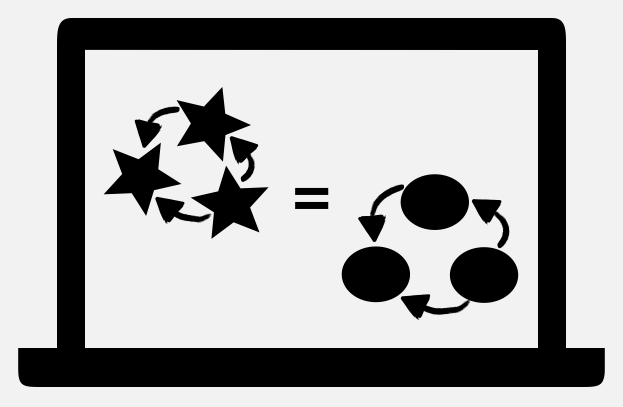
The ripening of fruit and audio feedback in an acoustic system are both examples of a positive feedback system (i.e. a system in which events continuously increase the magnitude of an outcome) .
Many phenomena can be described by an abstract causal system (e.g. positive & negative feedback loops, causal chains of events).
Question
Do children (and adults) recognize when systems share a common causal system?
Impact
This research study is the first evidence that children can recognize similar causal systems. This lays the groundwork for the creation of STEM interventions to facilitate learning about scientific systems.
Deliverables: Talk at Cognitive Development Society conference; Research manuscript
Project Overview
Role: Project Lead, end-to-end research
Methods:
- Usability testing (focus groups; online survey)
- A/B testing (one-on-one interviews via Zoom)
- statistical analysis (logistic regression)
Challenges:
- Study had to be conducted entirely online
- Materials needed to be simple enough for children to understand
- Limited budget for design and study execution
Literature Review
Children are good at learning some types of abstract information, like that the category of “carnivore” includes different animals that share the property of eating meat, like sharks and lions.
But, we don’t know if children can recognize that different processes can share the same abstract causal system. For example, a positive feedback loop is one type of system in which events have a positive impact on one another, increasing the magnitude of an outcome (e.g. how ripe a piece of fruit is, or how loud audio feedback is).
This refined the research question: Can children recognize when dissimilar events share the same causal system?
Usability Testing
Tested the accessibility of images and animated videos using focus groups (5-10 adults) and online surveys.
I used focus groups and online surveys to design the study materials. Usability testing revealed that static images made it difficult for viewers to figure out an event’s underlying causal system (e.g. that wind and waves can both, independently, cause a sandcastle to fall down).
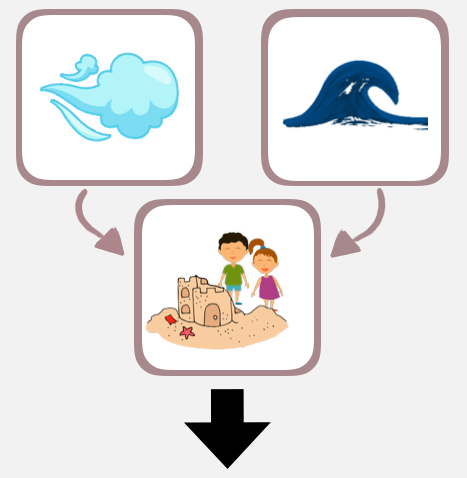
To make events easier to understand, I altered the design from static images to animated videos.
We found it was easier for people to figure out how causes were related to their effects when watching a video.
A/B Testing
I compared the age at which children (4- to 7-year-olds; adults) could successfully match events based on their underlying causal system.
Participants were randomly assigned to see different combinations of events and select the matching pairs. Using R, I ran model comparisons to examine whether there were differences in the age at which children successfully matched events based on their underlying causal system.
We found that by the age of 6 and into adulthood, participants were able to recognize similar systems across unique events.
Conclusions & Recommendations
Recognition of relational categories has been proposed to play a key role during learning of complex scientific concepts. This study suggests that emphasizing causal system categories can help young learners recognize the abstract features of the phenomena they observe.
Here, we incorporated a variety of techniques to support children’s causal reasoning, including the use of causal diagrams. Open questions remain about the role of these diagrams in supporting children’s similarity judgments, and whether they would have spontaneously matched causal system categories in the absence of these visual scaffolds.
 Alex Rett